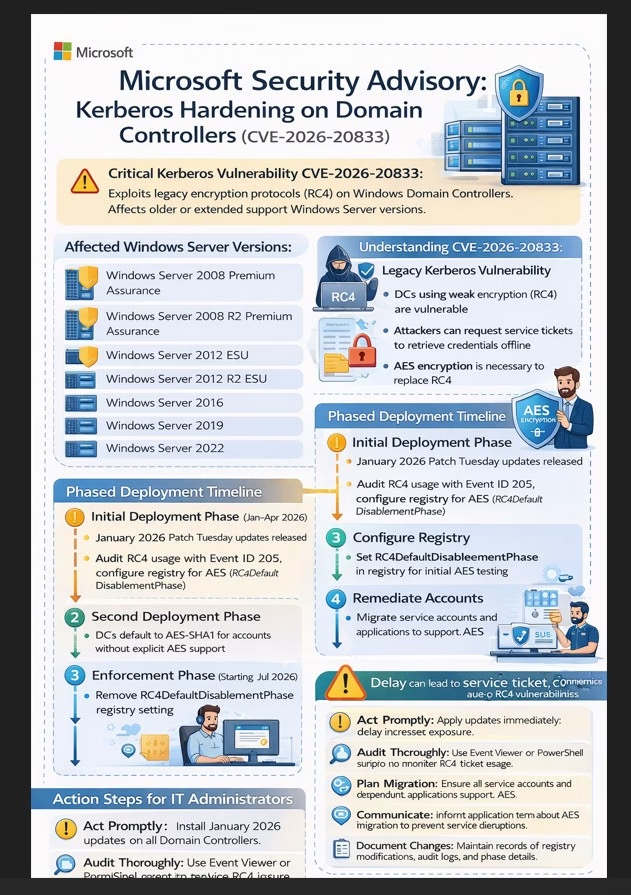
Microsoft has issued a critical advisory for IT administrators managing Windows Domain Controllers (DCs), targeting the mitigation of CVE-2026-20833, a Kerberos vulnerability that exposes legacy encryption protocols like RC4. This vulnerability allows attackers to request service tickets and potentially compromise service account credentials, particularly on DCs running older or extended support versions of Windows Server.
Affected Windows Server editions include:
- Windows Server 2008 Premium Assurance
- Windows Server 2008 R2 Premium Assurance
- Windows Server 2012 ESU
- Windows Server 2012 R2 ESU
- Windows Server 2016
- Windows Server 2019
- Windows Server 2022
- Windows Server 2025
Understanding the Vulnerability
CVE-2026-20833 is a Kerberos protocol flaw that enables attackers to exploit weak or legacy encryption algorithms. Specifically:
- Service accounts using RC4-HMAC or other outdated encryption types are vulnerable.
- Attackers can request service tickets for these accounts and conduct offline attacks to retrieve credentials.
- DCs issuing RC4-based tickets are at risk until administrators migrate to AES-based encryption.
This advisory marks a continuation of Microsoft’s long-term Kerberos hardening strategy, ensuring DCs adopt secure cryptography without breaking legacy systems prematurely.
Phased Deployment Approach
Microsoft is implementing mitigations in three phases to balance security and operational compatibility:
1. Initial Deployment Phase (Jan – Apr 2026)
- Purpose: Monitor and audit potential RC4 usage without enforcing changes immediately.
- Updates: January 2026 Patch Tuesday updates introduce:
- Audit events (KDCSVC Event ID 205) to log service account tickets still using RC4.
- New registry value:
HKLM\System\CurrentControlSet\Control\Lsa\Kerberos\Parameters\RC4DefaultDisablementPhaseThis setting allows DCs to default to AES-SHA1 for service accounts when safe.
- Recommended Actions for Admins:
- Install updates on all affected DCs.
- Review audit events for RC4 usage.
- Identify service accounts or applications dependent on RC4 and plan remediation.
2. Second Deployment Phase (starting Apr 2026)
- DCs begin issuing AES-SHA1 encrypted service tickets for accounts that do not have the
msds-SupportedEncryptionTypesattribute defined. - Admins should ensure:
- All critical service accounts are configured to support AES encryption.
- Applications relying on Kerberos authentication are tested for compatibility with AES.
3. Enforcement Phase (starting Jul 2026)
- RC4DefaultDisablementPhase registry key will be removed.
- DCs will fully enforce AES encryption, no longer issuing RC4 tickets.
- This phase represents complete mitigation of CVE-2026-20833.
Step-by-Step Guidance for IT Administrators
Step 1: Apply Updates
- Install January 2026 Patch Tuesday updates on all Domain Controllers.
- Confirm updates have installed successfully via Windows Update history or WSUS logs.
Step 2: Monitor Audit Events
- Open Event Viewer → Windows Logs → System
- Look for KDCSVC Event ID 205, which indicates RC4 service tickets are still being issued.
- Example of an event:
Event ID: 205 Source: Microsoft-Windows-Kerberos-Key-Distribution-Center Message: KDC issued a service ticket using RC4-HMAC for account <AccountName>
Step 3: Configure Registry for Initial Deployment
- Navigate to:
HKEY_LOCAL_MACHINE\SYSTEM\CurrentControlSet\Control\Lsa\Kerberos\Parameters - Add or modify the DWORD value:
RC4DefaultDisablementPhase = 1 - This enables DCs to preferentially use AES-SHA1 when compatible.
Step 4: Remediate Incompatible Accounts
- Identify service accounts or legacy applications still requiring RC4.
- Update their msds-SupportedEncryptionTypes attribute to include AES support.
- Test applications for AES compatibility before moving to the second deployment phase.
Step 5: Transition to Enforcement Phase
- Once all KDCSVC audit events indicate no RC4 usage, admins can safely remove the RC4DefaultDisablementPhase key.
- After removal, DCs will reject RC4 tickets, fully mitigating CVE-2026-20833.
Key Recommendations
- Act promptly: Apply updates immediately; delaying increases exposure.
- Audit thoroughly: Use Event Viewer or PowerShell scripts to monitor RC4 usage.
- Plan migration: Ensure all service accounts and dependent applications support AES.
- Communicate with stakeholders: Inform application teams about AES migration to prevent service disruptions.
- Document changes: Maintain records of registry modifications, audit logs, and phased implementation.
For a full, detailed walkthrough, including registry configurations and troubleshooting tips, IT administrators can access Microsoft’s official guide here. How to manage Kerberos KDC usage of RC4 for service account ticket issuance changes related to CVE-2026-20833 – Microsoft Support