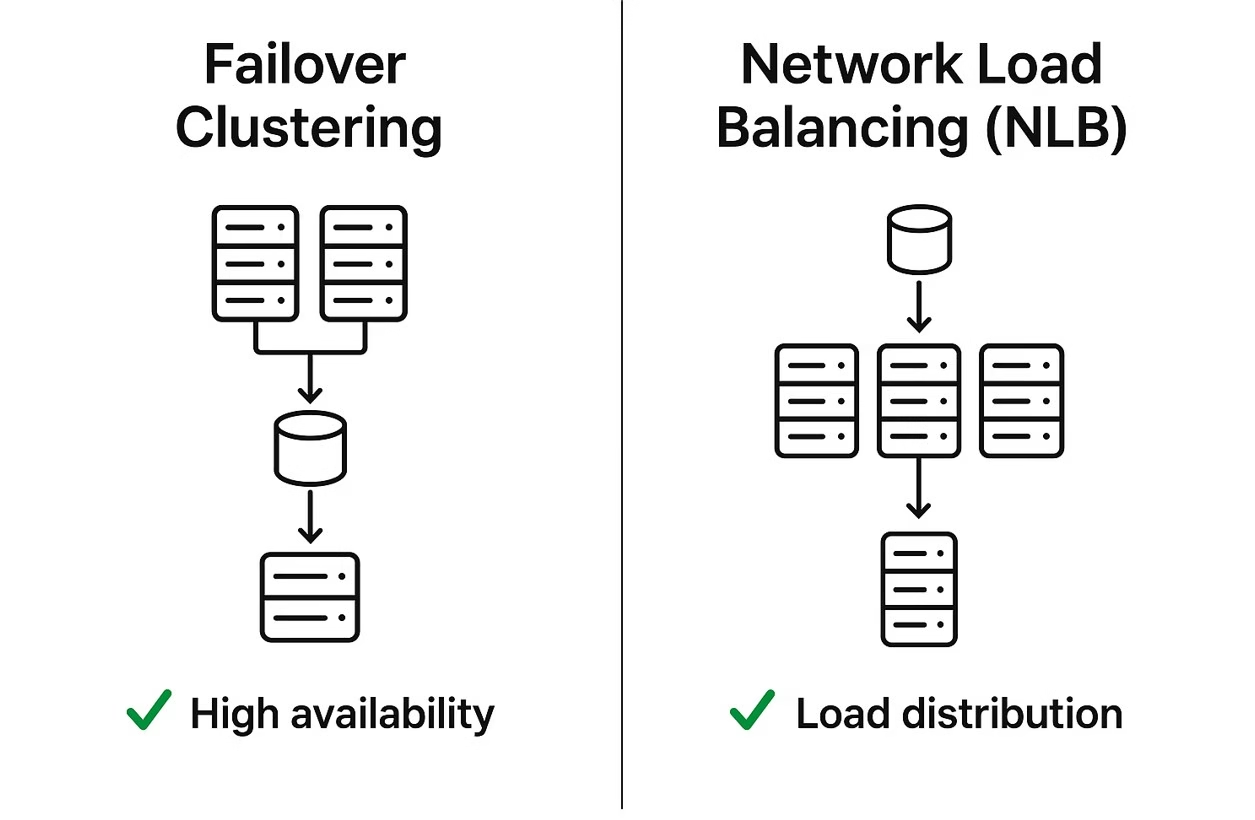
Building highly available and scalable systems is a core requirement for modern IT infrastructures. Two technologies often used to achieve this reliability are Failover Clustering and Network Load Balancing (NLB). Although both aim to improve service continuity, they solve different problems and operate in distinct ways.
This article provides a deep dive into how each technology works, their architectural differences, and when you should choose one over the other—or use both together.
🔍 Quick Comparison Overview
| Feature | Failover Clusters | Network Load Balancing (NLB) |
|---|---|---|
| Primary Goal | High availability (minimize downtime) | Distribute traffic for scalability |
| Best For | Critical stateful applications | Web & stateless apps handling heavy traffic |
| Failover Supported? | ✔ Yes – seamless failover | ✖ No true failover (only node removal) |
| Shared Storage | Often required | Not required |
| Focus | Redundancy + service continuity | Performance + load distribution |
| Examples | Databases, File servers, Hyper-V | Web servers, Email front-end, Gateways |
1. Failover Clustering
Failover clustering is designed for high availability—ensuring critical workloads remain operational even when hardware or software failures occur.
What Failover Clusters Do
A failover cluster groups multiple servers (called nodes) to work together. If one node fails, another node automatically takes over the workload. This process—called failover—is usually fast and minimally disruptive.
Primary Objective
✔ Maintain continuous service availability
✔ Prevent downtime for critical systems
✔ Ensure data consistency via shared storage
How Failover Clusters Work
- Nodes continuously monitor each other.
- If a node stops responding:
- Cluster service triggers a failover
- Workloads automatically shift to a healthy node
- Shared storage ensures all nodes access the same dataset.
Key Components
- Shared Storage (SAN/NAS): Ensures data consistency.
- Clustered Workloads: Applications configured to move between nodes.
- Heartbeat Communication: Used to detect node failures.
Typical Use Cases for Failover Clustering
Failover clustering is ideal when even a few seconds of downtime is unacceptable:
✔ Database Servers (SQL, Oracle)
To ensure transactions and data remain intact.
✔ File Servers
Consistent access to shared files.
✔ Hyper-V / VM Hosts
Virtual machines stay online even if a host crashes.
✔ Critical Enterprise Applications
ERP, email servers, domain controllers.
2. Network Load Balancing (NLB)
Network Load Balancing is focused on scalability and traffic distribution, not duplicated workloads or shared storage.
What NLB Does
NLB distributes incoming network requests across multiple servers. This prevents any single server from becoming overloaded.
Primary Objective
✔ Improve performance
✔ Support high volumes of traffic
✔ Scale applications horizontally
How NLB Works
- Multiple servers join an NLB cluster/pool.
- All servers share one Virtual IP (VIP).
- The NLB algorithm (round robin, affinity modes, etc.) selects which server handles each request.
- If a server fails:
- NLB stops sending new requests to it
- But ongoing sessions may break (no true failover)
Key Components
- Multiple identical servers
- Virtual IP for the pool
- Load-balancing algorithms
Typical Use Cases for NLB
NLB is best for stateless or easily replicated workloads:
✔ Web Servers
For large traffic websites and portals.
✔ Stateless Application Servers
APIs, microservices, and app front-ends.
✔ Proxy / Gateway / VPN Servers
✔ Email Front-End Load Balancing
(Example: Exchange CAS role)
3. Failover Clustering vs NLB: Which Should You Choose?
Choosing the right solution depends on your business and technical requirements.
Choose Failover Clusters if:
✔ Application must remain online 24/7
✔ You need automatic failover
✔ The application is stateful (databases, file services)
✔ Data consistency is critical
Choose NLB if:
✔ You need to handle high traffic volume
✔ Application is stateless or sessions can be synced
✔ You want horizontal scaling
✔ Shared storage is not required
4. Can They Work Together?
Absolutely—many enterprise architectures combine both technologies:
Example Setup
- Web Layer → NLB cluster to distribute traffic
- Database Layer → Failover cluster for zero downtime
This hybrid architecture is common in large web applications.
5. Summary
Failover Clustering and Network Load Balancing each play a unique role:
- Failover Clustering = High Availability
- NLB = Load Distribution & Scalability
Choosing the right solution depends on application design, statefulness, performance demands, and tolerance for downtime.
To build resilient enterprise systems, organizations often use both—NLB for front-end scalability, and failover clusters for back-end reliability.